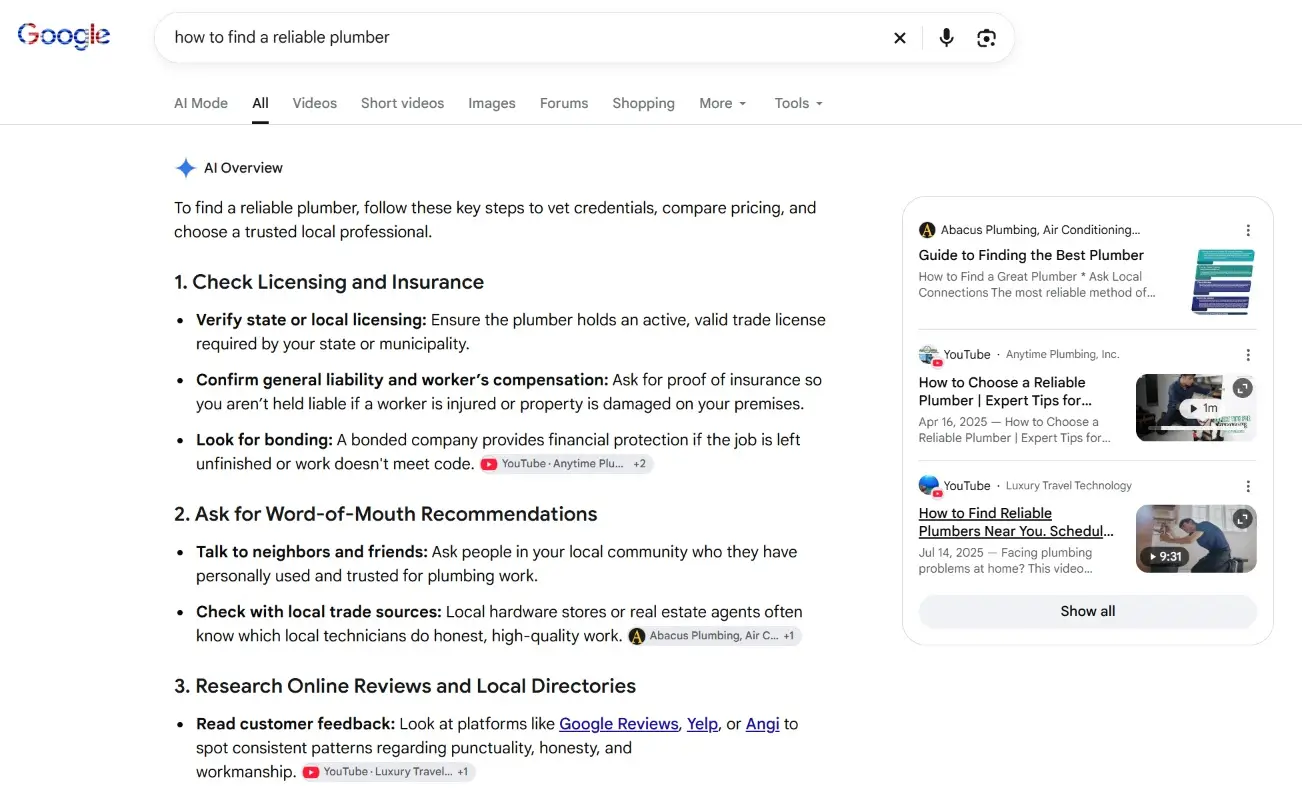
Do AI Overview Responses Remain Consistent Over Time for the Same Query?

Search engine optimization (SEO) is the work of making a page rank in search results. Generative engine optimization (GEO) is the work of making a page cited in an AI-generated answer. Both depend on what the AI shows, and I wanted to know whether what it shows stays the same. I took 20 unbranded searches and loaded each one three times in one evening, then did the same thing again the next evening. The AI Overview never disappeared once. The answers, though, kept moving.
How I Tested Whether AI Answers Stay the Same
The test used 20 unbranded queries across health, money, tech, home, food, travel, education, jobs, local services, shopping, fitness, small business, pets, parenting, and beauty. Each query was one I had already used in the 300-search study, and each one had shown an AI Overview there. I ran them on live Google, signed out, in US English, on desktop. Each query loaded three separate times, in spread rounds: all 20 queries once, then all 20 again, then all 20 a third time. That made 60 loads on Monday, November 9, and 60 more on Tuesday, November 10. For each load I recorded whether the AI Overview appeared, a short summary of the answer, and every citation in order.
What the Test Found
On Monday evening, the AI Overview appeared on all 60 loads. 17 of the 20 queries came back identical across all three loads, in wording and in citation order. Three came back different: one on memorizing vocabulary for a test, one on finding a reliable plumber, and one on the best wireless headphones under 100 dollars.
On Tuesday evening, the AI Overview again appeared on all 60 loads. 16 of the 20 came back identical across all three loads. The same three queries were unstable again, and one more joined them: composting kitchen scraps, which kept its core steps but changed its citations on every load.
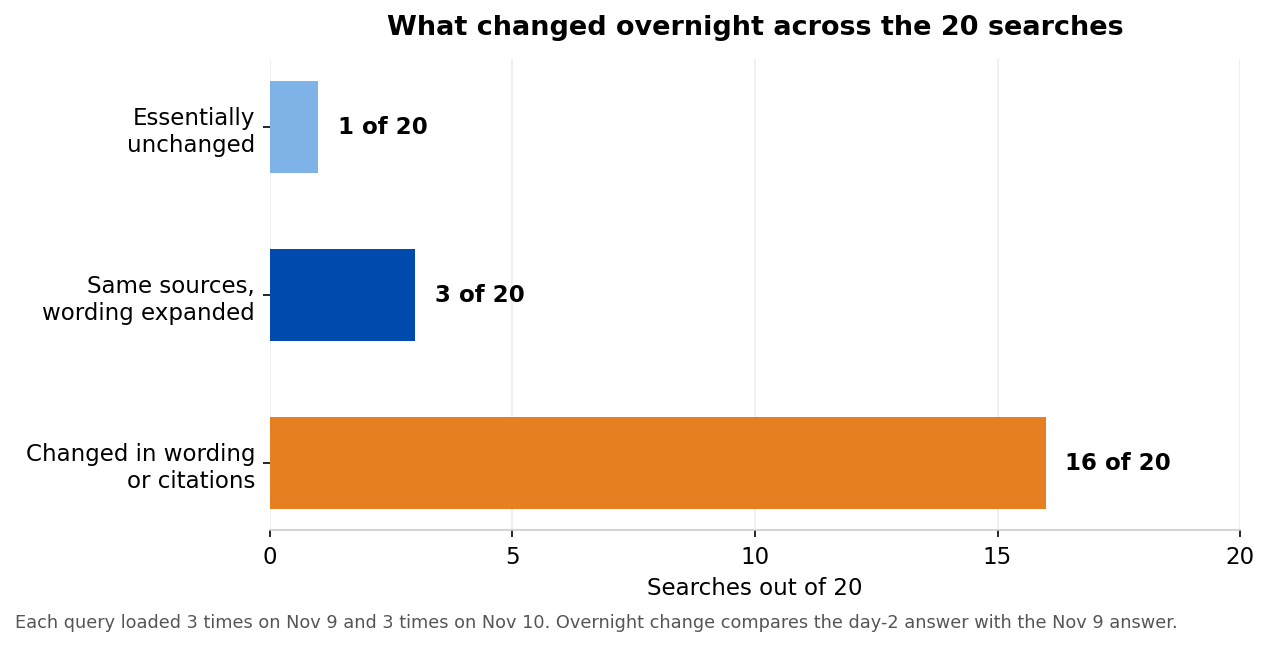
The overnight comparison is where the movement shows most. Only one of the 20 queries came back essentially unchanged from Monday to Tuesday: how to unclog a drain. Three kept the same sources with the wording expanded. The other 16 changed in wording, in citations, or in both.
The biggest changes were in numbers. For the best jobs for introverts, the salary figures shifted: software developer from $131,450 to $110,140, and information security analyst from $124,910 to $107,140. The job list itself changed as well. For headphones under 100 dollars, the product lineup changed on every load, and the prices moved too: the JLab went from $84.99 to $89.98, and the Life Q30 fell to $49.99. For finding a plumber, Tuesday brought three new variants with figures Monday did not have, including journeyman 4 to 5 years, master 7 plus years, and a $500,000 insurance minimum. The vocabulary answer was reframed around the W.R.A.P. method, and the acne scars answer was reframed around permanent indentations versus dark spots.
Prices and salary figures were the most fragile facts in the answers. They moved overnight, and the headphone prices kept moving load to load within a single evening.
What I Conclude From These Findings
The time gap matters, and a day is enough for it to show. Within one evening, most answers held still: 17 of 20 on Monday, 16 of 20 on Tuesday. A day later, 16 of 20 had moved. The three queries that were unstable within a day on Monday were unstable again on Tuesday, which suggests some topics regenerate more than others. Product and job queries moved the most because their answers carry prices and salary figures that change.
But no query changed what it recommends. The cholesterol answer still says cut saturated fat and eat soluble fiber. The vocabulary answer still says use active recall and spaced repetition. The plumber answer still says verify credentials and get written estimates. What moved was the wording, which sources were cited, and the numbers attached to products and jobs. The relevance of the answer to the query did not move.
That is the point of the test. A citation list from one load is a snapshot of that load. It is not a stable finding. A study that quotes a citation list or a price from a single load is quoting one moment. The durable part of an answer is the page content and its relevance to the search, and that is what a page should be optimized for.
What This Means for You
If you write pages to be cited in AI answers, do not chase the citation list from one load. It can change by the next evening, and the prices and figures in it can change faster than that. Build the page around a direct answer that sits early, in a format the AI can quote, and keep the facts on it current. The AI will keep regenerating its answers, and the pages it quotes will keep changing with it. The pages that stay quotable are the ones whose answers stay clear, direct, and relevant to the query.
Sources
- Refresh-stability dataset, November 9, 2026: 20 queries, 3 loads each, 60 loads (refresh-stability-dataset.csv)
- Refresh-stability dataset, day 2, November 10, 2026: 20 queries, 3 loads each, 60 loads (refresh-stability-dataset-day2.csv)
- The 300-search study dataset: 300 unbranded queries on Google and Bing, 600 search pages (geo-aeo-study-dataset.csv)