I Ran 300 Searches on Google, and Here Is What This Study Taught Me About GEO

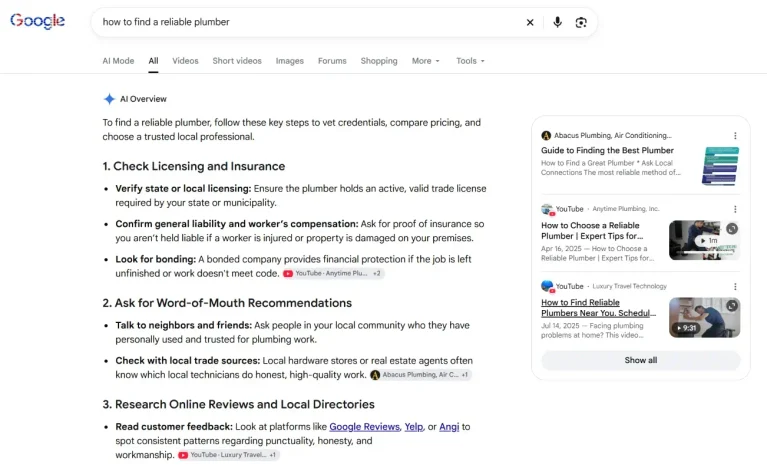
Search engine optimization (SEO) has not died. It has evolved, and generative engine optimization (GEO) is part of that evolution. GEO is the work of getting your pages cited in AI answers. It is not replacing SEO. It is SEO done with an AI answer in mind, and it is becoming the part of SEO to optimize for, because the AI Overview now sits at the top of the page. When someone types a query into Google now, the first thing they often see is not a list of links. It is an answer, written by Google, with a handful of sources cited underneath it. I wanted to know what those cited pages have in common, so I ran an experiment. I took 300 unbranded queries, the kind real people type when they do not have a brand in mind, and I searched each one live on Google. Then I opened the cited pages to see where the cited answer sits and what format it uses. This post covers the pattern I found, how I ran the study, what else I found, and what I conclude from the findings.
Table of Contents
What the Cited Pages Have in Common
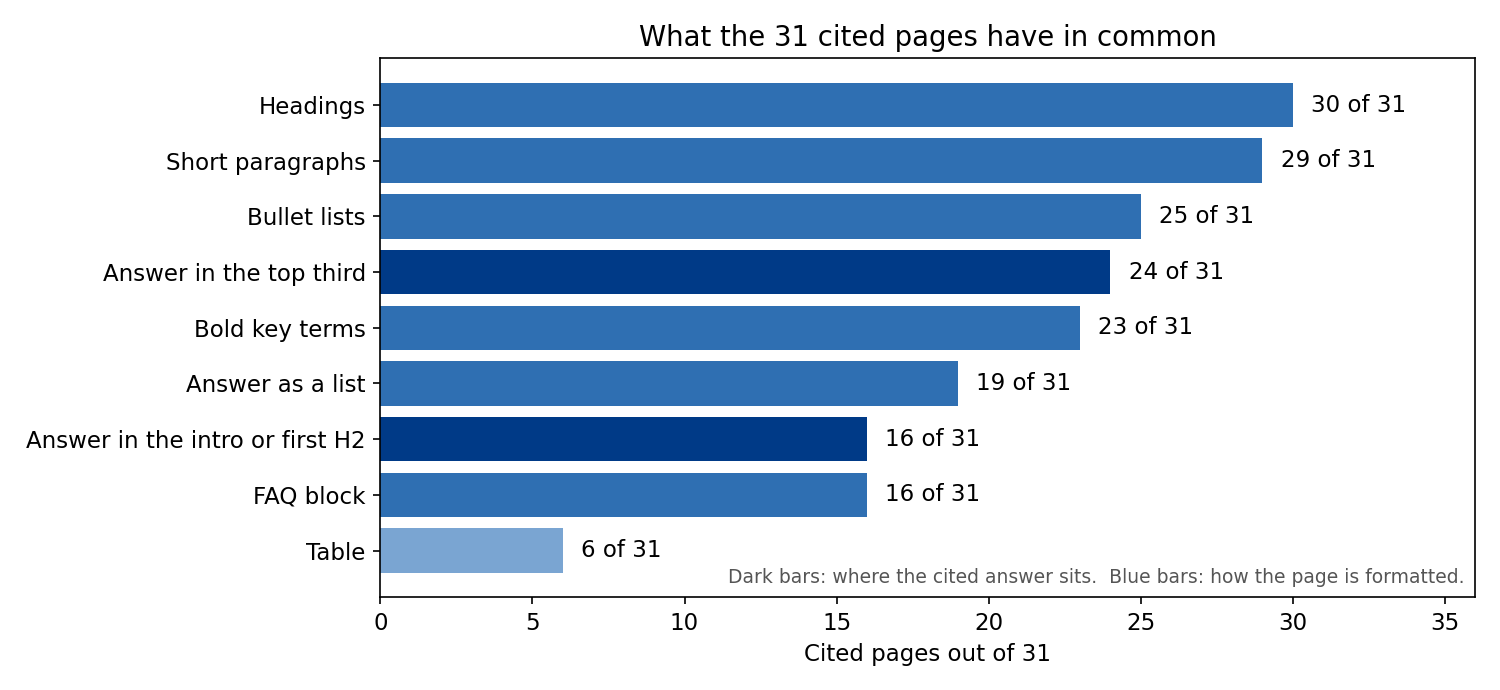
The study opened 36 of the cited pages, and 31 of them could be read and classified. The chart above shows what those 31 pages have in common. The cited answer sits in the top third of the page on 24 of 31 pages, and in the intro or the first H2 section on 16 of 31. It takes the form of an unordered list on 19 of 31, an ordered list on 11, and a recommendation list of named products on 8. Headings, short paragraphs, bullet lists, and bold key terms are near universal across the 31 pages, while FAQ blocks appear on about half and tables on only 6 of 31. Length does not decide it. The shortest cited page ran about 60 words and the longest about 4,500, with a median near 1,200. The pattern is the same for pages that rank in the classic top five and for pages that do not, so there is no separate page shape for winning the AI answer without ranking. The course teaches the structure that follows from this pattern, one rule at a time.
How I Ran the Study
The study used 300 distinct unbranded queries, with 20 queries in each of 15 topics:
- Health
- Money
- Tech and AI
- Home and DIY
- Food
- Travel
- Education
- Jobs
- Local services
- Shopping
- Fitness
- Small business
- Pets
- Parenting
- Beauty
The queries mixed how-to, best, what-is, and how-much and how-long queries. I searched each query live on Google, signed out, on desktop, which gave 600 search pages in total. For each page, I recorded whether an AI answer appeared, which pages it cited and in what order, which brands it named, the top five organic results, and whether any cited page also appeared in that organic top five.
Of the pages cited on those 300 search pages, I opened 36. For each one, I recorded where the cited answer sits on the page and what formatting it uses.
What the Study Found
Google showed an AI Overview on 296 of the 300 queries, which is nearly every time. The only four queries without one were all local searches, the kind where a map and a list of nearby businesses take over the page instead. Those four were best hair salon near me, best auto mechanic near me, best pizza delivery near me, and best coffee shops in Idaho Falls.
The cited page also ranked in the classic top five in 222 of the 296 AI answers, which is about three in four. Ranking still matters. But in 74 of the 296, which is one in four, the AI answer cited a page that did not rank in the top five at all. Those pages won the answer without winning the ranking, and they are the reason this study matters for a website owner.
The overlap was weakest in Health, where only 7 of 20 cited pages also ranked in the top five, and in Money, where only 11 of 20 did. Beauty was the only topic with full overlap at 20 of 20. By query type, best queries overlapped least, with 71 of 103 cited pages also in the top five. A best query is really a recommendation list, and the AI answer builds that list from pages that do not have to rank first.
The AI answers named a brand in 252 of the 296 cases, which is 85 percent, even though none of the queries named a brand. An unbranded query still gets a branded answer. The brands that show up are the ones whose pages give the AI something specific to quote.
The AI answers cited 1,682 sources in total, with a mean of 5.7 citations per answer and 745 distinct domains. The most cited source in the whole study was not a publisher. It was YouTube, with 381 of the 1,682 citation slots, which is nearly a quarter, followed by Reddit with 125. Those counts are snapshots of one run, and a later run can cite different sources. The pattern that holds is that the AI answer treats a video and a forum thread as sources on equal footing with an article.
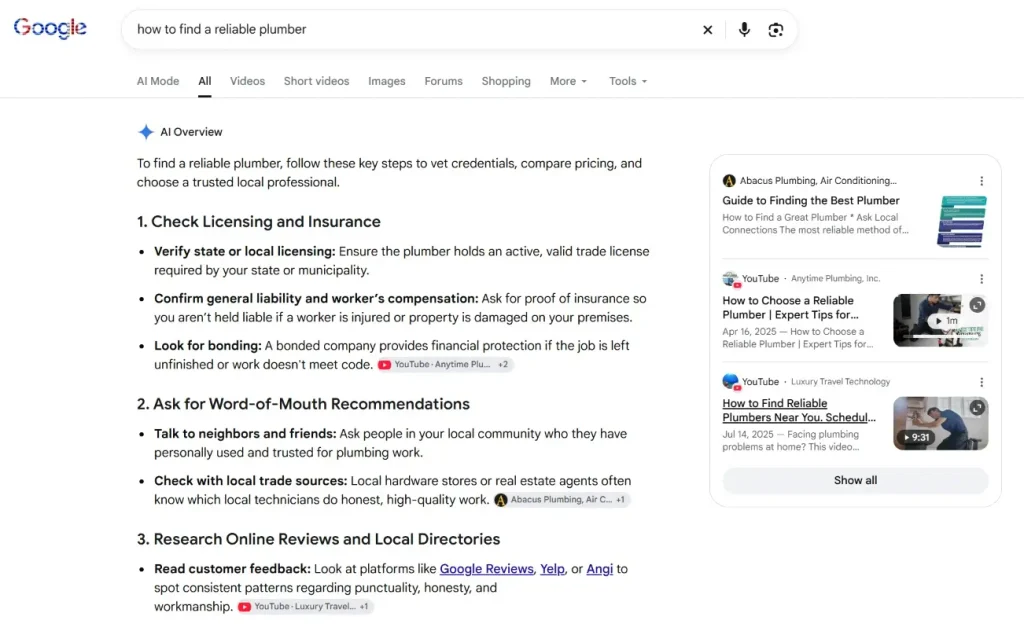
One more finding is worth naming. AI answers regenerate between visits. One query showed no citations on the first load and a completely different answer with different citations on a later visit. These answers are snapshots of a single load, and a later visit can show a different answer. A follow-up test loaded 20 queries three times each in one evening, and 3 of the 20 came back different.
What I Conclude From These Findings
The top of the page is now an answer, and the answer cites its sources. That is the surface a website owner is competing for now, and it sits above the classic results.
That shift changes the word we use: In the classic results, a page ranks, but in the AI answer, a page is visible. The 74 pages that won the answer without ranking in the classic top five prove the difference, because they were visible in the answer even though the classic list did not rank them. The AI answer gives visibility, and the classic list gives ranking.
Ranking and citation are related, but they are not the same thing. Ranking helps, since the cited page also ranked in three out of four AI answers, but ranking is not required, since one in four AI answers cited a page outside the top five. Therefore, a page has two surfaces to compete for: the classic ranking and the AI answer, and the second one can be won without the first.
SEO has not changed into something else. It has evolved, and GEO is the part of it that the AI answer has made urgent. Keywords still matter, but they matter less than they used to, because the AI can understand what a page means even when the page does not use the exact words in the query. That gives more room for what you mean in your topic to perform. If the AI sees that your content means the same thing as the query, it will cite your content and show it, even without the exact words. That is why I ran this study. I wanted to find what to add to the way we do SEO, now that AI is doing the understanding.
Unbranded queries still produce branded answers, which means brand presence in AI answers is earned by giving the AI something specific to quote. Furthermore, the citation surface is wider than articles. Video and forum threads count as sources, so a video or a community discussion can carry a brand into an answer that an article never reached.
For “near-me” queries, the local pack replaces the AI answer entirely, so a local business competes on a different surface again. The pattern is the same in each case. The search page has more than one surface now, and each surface has its own way in.
The work, therefore, grows rather than changes hands. A page still needs to rank, and now it also needs to be quotable. That growth is the deduction of this study, and the course teaches the structure that follows from it, one rule at a time.
What This Means for You
If your business depends on being found through search, the surface you are competing for has grown. SEO is still relevant, and GEO is now part of it. Your pages need to be quotable as well as rankable.
Sources
- The study dataset and analysis: 300 live unbranded queries, 600 search pages, run November 9, 2026. Google AI Overview on 296 of 300 queries, cited page also in the organic top five on 222 of 296, brands named in 252 of 296 AI answers, and YouTube most cited with 381 of 1,682 citation slots; 36 cited pages opened, 31 read and classified for answer position and format.
- Google Search Central, Optimizing your website for generative AI features on Google Search. Google states that AI features are built on the same core Search ranking and quality systems, using retrieval from the existing Search index, and that no special schema or llms.txt file is required.
- Google Search Central, AI features and your website. Google states that a page must be indexed and eligible to be shown in Google Search with a snippet to be shown as a supporting link in AI Overviews or AI Mode, with no additional technical requirements.
- Google Search Central Blog, Introducing Search Generative AI performance reports in Search Console. Google introduced dedicated reports for visibility within generative AI features, with impressions only.