Are Keywords Still Relevant in SEO?

Keywords used to be the whole game in search engine optimization (SEO). You found the words people typed; you put them in the right places, and you ranked. Then the AI Overview arrived at the top of the page, and a new doubt appeared. That change gave rise to a new term, generative engine optimization (GEO), which is the work of getting your pages cited in those AI answers. If the AI understands meaning, do the exact words still matter? I ran a test to prove that meaning is what counts most now, and the answer is more interesting than a simple yes or no.
How I Tested Whether Keywords Still Matter
I took 25 pairs of queries with the same intent in each pair. The exact version contained a distinctive keyword. The other version was a paraphrase, and it asked the same thing without ever using that keyword or any form of it. Every pair was checked mechanically before the test ran: each exact version contains its keyword, and no paraphrase contains it.
The pairs covered all 15 topics from my larger study, with 16 how-to intents, 6 best intents, and 3 what-is intents. Each query was run live on Google, signed out, on desktop, one load each, which gave 50 live searches in total. For each search, I recorded whether an AI Overview appeared, which pages it cited and in what order, and the top five organic results. Each query was loaded once, so the citation lists in this test are snapshots of one load. A later load of the same query can cite different pages, which a follow-up test confirmed.
This test follows the larger study behind I Ran 300 Searches on Google and Bing, and Here Is What This Study Taught Me About GEO, where the AI Overview appeared on 296 of 300 queries. That study led me to the reasoning this post states plainly: keywords still matter, but they matter less, because the AI can understand what a page means even when the page does not use the exact words in the query. This test checks that reasoning against live results.
What the Test Found
The AI Overview appeared on all 50 searches, 25 of 25 exact versions and 25 of 25 paraphrase versions. Dropping the keyword never stopped the answer from appearing. The AI understood the meaning in every paraphrase and answered it.
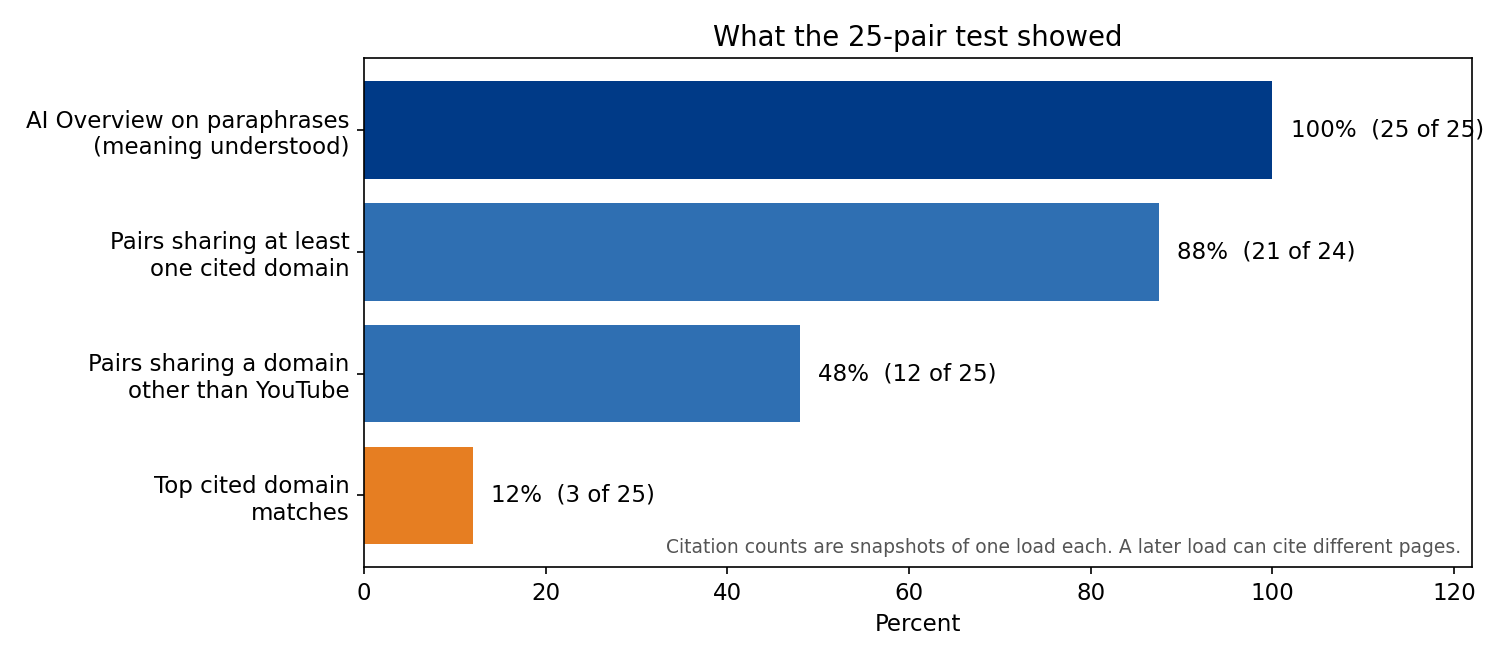
The citation numbers below are snapshots of that one load. A later load of the same query can cite different pages.
The citations tell a subtler story:
- In 21 of the 24 pairs that could be compared, the paraphrase answer cited at least one of the same domains as the exact version.
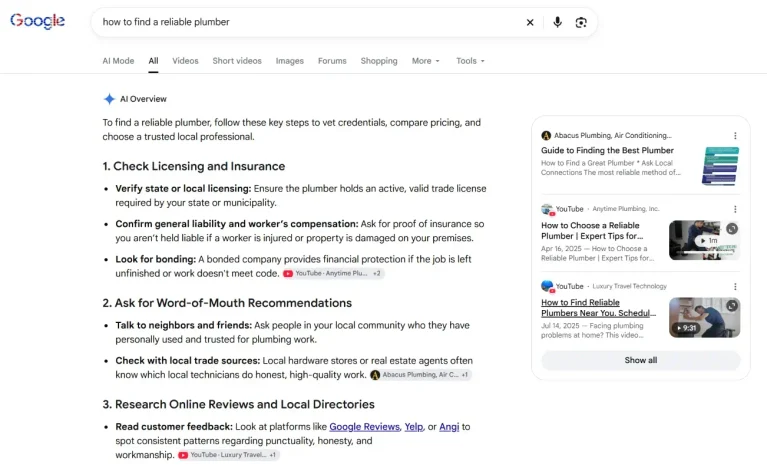
- In 3 pairs, the two versions shared no cited domain at all. Those were the pairs about the best time to visit Paris, finding a reliable plumber, and the best wireless headphones under 100 dollars.
- In 1 pair, the two versions could not be compared at all, because the paraphrased answer about putting a small amount of cash to work showed no citations on that load.
- The overlap was thin. In 12 of the 24 pairs, exactly one domain was shared. Three domains were shared in 4 pairs, and two domains were shared in 5 pairs.
- The top cited domain matched in only 3 of the 25 pairs.
- The number of citations was close on both sides, with a mean of 7.7 citations per answer for the exact versions and 7.0 for the paraphrase versions.
- The cited domain also appeared in the organic top five on 22 of 25 exact versions and 19 of 25 paraphrase versions.
YouTube was the shared domain in 17 of the 21 sharing pairs, and it was the only shared domain in 9 of them. Only 12 of the 25 pairs share a cited domain other than YouTube. When the wording changes, video is the source both versions reach for.
How Important Are Keywords in GEO?
The AI understands meaning without the exact words. It answered every paraphrase, and it cited sources for nearly every one. A page does not need the exact words in the query to be cited for that query. That is the part of the old keyword game that has genuinely changed.
But the exact words still steer which pages get cited. The two versions mostly cited different pages for the same intent, and the top cited source matched in only 3 of 25 pairs. Change the wording, and the AI reaches for different pages, even when it understands the same meaning. That is the part of the keyword game that is still alive.
One caution belongs here. A reload of the same query can also cite different pages, so the difference between the two versions is partly the wording, and partly the reload itself. On this run, the wording steered the sources, and the steering is real but not clean: the same version reloaded can reach for different pages too.
Keywords now work as a steering signal. They point the AI toward certain pages, but they no longer decide whether the AI answers at all. Meaning carries the query, and wording steers the sources. That is the finding in one sentence, and it is the reason this post does not end with a simple yes or no.
SEO has not died. It has evolved, and GEO is part of that evolution. Keywords are one part of the work now, and they are no longer the whole work. The practical meaning is straightforward. Write for the meaning first, use the words people actually use, and cover the intent fully, so the AI has something specific to quote. Stuffing exact phrases into a page will not save a page that says nothing useful, and a page that says something useful will not be invisible just because it skips one exact phrase.
The Takeaway
If your pages depend on search, keywords are still part of the work. They are no longer the whole work. The AI will answer a query even when your page never uses its exact words, and it will cite the pages that say what the searcher means. Write for the meaning, keep the words people use, and give the AI something specific to quote. That is how a keyword earns its place in GEO.
Sources
- The keyword pairs study dataset: 25 pairs of queries, 50 live Google searches, run November 9, 2026, one load per query. AI Overview on 25 of 25 exact versions and 25 of 25 paraphrase versions; shared cited domain in 21 of 24 comparable pairs; top cited domain matches in 3 of 25; mean citations 7.7 exact versus 7.0 paraphrase; cited domain also in organic top five on 22 of 25 exact versions and 19 of 25 paraphrase versions; YouTube the shared domain in 17 of 21 sharing pairs. Each citation count is a snapshot of one load.
- The GEO/AEO study dataset: 300 live unbranded queries, 600 search pages, run November 9, 2026. Google AI Overview on 296 of 300 queries, cited page also in the organic top five on 221 of 296.
- Google Search Central, Optimizing your website for generative AI features on Google Search. Google states that AI features are built on the same core Search ranking and quality systems, using retrieval from the existing Search index, and that no special schema or llms.txt file is required.
- Google Search Central, AI features and your website. Google states that a page must be indexed and eligible to be shown in Google Search with a snippet to be shown as a supporting link in AI Overviews or AI Mode, with no additional technical requirements.